
Feature

Carmen demands a little more attention from her husband, Ibón, but his work monopolizes her time so that they can barely meet together. Oscar, their son, tries to get his parents to listen to him, but they are always “on their own business”. Furthermore, Óscar has problems at school that he doesn't know how to solve, because he can't wait to tell them at home. He also demands more attention. One day Carmen discovers that Ibón has more reasons, not just work reasons, for seeing them so little. After confirming his suspicions, he decides to take drastic measures. Oscar now becomes the epicenter of his parents, who use him as a bargaining chip between their interests, but continue not to pay attention to the little one's demands. By the time they realize it, it will be too late. Until then, everyone will have done their own thing. Now, there is nothing to do.

On the coast of her native Cantabria, where the sound of the sea permeates everything, lives Elena. She is married to the love of her life: a kind and attentive man, a sailor by profession, who works aboard a fishing boat. They have a daughter, Alba, nine years old, who is their greatest joy and the center of their lives. The boat on which her husband sails has been gone for several days without returning to port, and the lack of news fills Elena with growing anxiety. At last, Elena’s happy world is shattered before her eyes in a single instant. She feels that life has lost its meaning, and grief drags her into despair, leading her to renounce even her deepest beliefs. As she recalls those happy moments, now lost forever, only her love for little Alba anchors her to the present and gives her the strength to overcome her pain and hold on to life once more. Between the harshness of reality and the tenderness of imagination, mother and daughter find a way to move forward, learning to live with loss. In that delicate balance between pain and love, the sea becomes the witness to an intim



Brothers Mic & Jim Conway have been playing music since school days, when they started the Jellybean Jug Band together, which subsequently morphed into the Captain Matchbox Whoopee Band. In the early 1970s Captain Matchbox were a tearaway success with old 1920s/30s tunes such as My Canary Has Circles Under His Eyes and comical tunes of their own, like Wangaratta Wahine. Mic loves visual entertainment and vaudeville, and creating instruments out of anything to hand. He has been in countless band line-ups over the last 40 years, and they all demonstrate his unique vision of performance, circus and vaudeville. Jim on the other hand is a natural musician and a blues one at that. He found his instrument early on in Captain Matchbox with the harmonica, proceeding to become one of Australia’s foremost blues harp players. As has been said of them, the brothers make sibling rivalry an art form, but they are also very close. At the age of 30 Jim was diagnosed with multiple sclerosis (MS), and this has gradually progressed over the last 40 years to the point where Jim is now virtually quadriplegic and can no longer play harmonica. Jim is married and Mic has his own family, but they have remained side by side through the years.
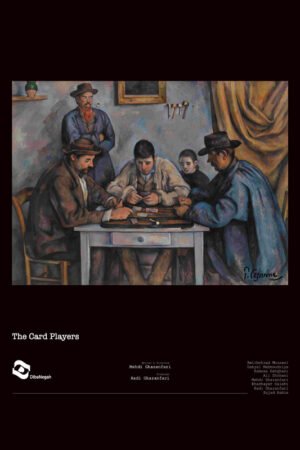
The film The Card Players is a free adaptation of the series of works by the French painter Paul Cézanne, bearing the same name. It consists of four episodes—Venus, Grafting the Vine, Grapes, and Bitter Wine—each with a different story.
In the episode Venus, symbolized by Diamonds, the main character has a deep connection with objects. Therefore, this episode places greater emphasis on objects. The main character is inspired by the standing café owner in Paul Cézanne’s painting The Card Players.
The episode Grafting the Vine, symbolized by Clubs, tells the story of a painter who portrays a woman in a garden. This episode emphasizes plants, and the main character is inspired by the figure on the right in Paul Cézanne’s painting The Card Players.
In the episode Grapes, symbolized by Spades, we see a young man living with several cats. The focus of this episode is on animals. The young man intends to make a change in his life of crime—not by abandoning it, but by committing crimes independently. This episode is inspired by the man on the left in Paul Cézanne’s painting The Card Players.
In the episode Bitter Wine, which follows Grafting the Vine and Grapes, we witness the brief companionship of two strangers. One is a man, an art dealer specializing in unknown painters, and the other is a woman, who previously appeared as a model in Grafting the Vine. The female character is inspired by the woman behind the two card players in Paul Cézanne’s painting The Card Players.
Symbolized by Hearts, this episode draws inspiration from the central figure in the painting. The two characters become travel companions for less than an hour.